
Adeje, 22 June 2026. Adeje brings together water safety, medical and rescue specialists to prevent drownings along the coast
“Prevención y Autoprotección en el Litoral” was the focus of a conference aimed at raising awareness of this issue. In the Canary Islands, more people die by drowning than in motorway traffic accident
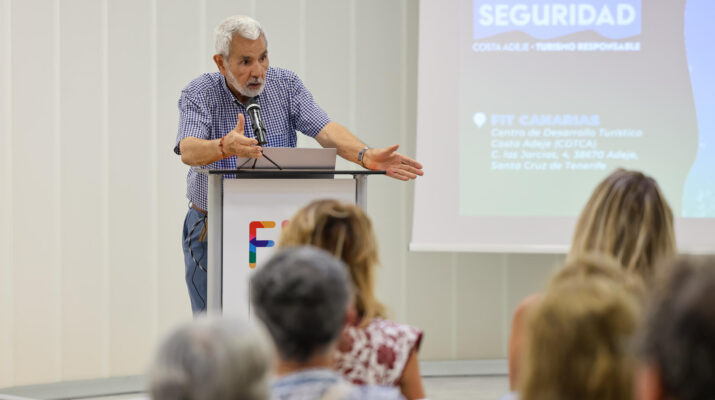
Adeje Town Hall’s, Department of Tourism under councillor Patricia Paulsen Fölling, held the conference “Prevención y Autoprotección en el Litoral” today, Monday 22 June, at the FIT Canarias facilities.
The event brought together specialists in medicine and rescue, municipal technicians, representatives of the local police and water safety experts to address, from a broad perspective, the prevention of drownings and accidents along the coast, both among residents and the visitors the municipality receives each year.
Adeje’s mayor, José Miguel Rodríguez Fraga, closed the conference by highlighting the municipality’s commitment to safety and prevention in all aquatic environments, not only along the coast but also in private and community swimming pools.
Rodríguez Fraga said the aim is “to anticipate the situations we may face, providing tools first to our residents, which is our main responsibility, and then to the tourists who arrive from places where there may not even be an ocean nearby, and who may face irreversible consequences”.
Patricia Paulsen Fölling, meanwhile, stressed that “prevention is the main way to avoid drownings on the coast and in swimming pools. We have before us a first-class panel of specialists and the objective is clear: enjoying the sea is a right, but protecting bathers is everyone’s responsibility. We are aiming for a one hundred per cent safe summer”.
The councillor also recalled that this conference is one part of the municipal campaign “Conocer el mar es seguridad”, (Know the Sea, Stay Safe) which has been delivering training in schools, to senior citizens’ groups and to the municipality’s security forces over recent months.
The conference was chaired by Eric Pestano, news director of Radio Club Tenerife of Cadena SER, the organisation behind the event, where, in addition to the issue of drownings, other coastal risks such as accidents and sun exposure were also addressed.
Daños solares y prevención
In this regard, the first speaker was Dr Inmaculada Mora Peces, a specialist in emergency medicine, who warned that “sun damage is cumulative, as if we were filling a glass drop by drop over our lifetimes. The damage builds up in the DNA and can lead to serious illnesses, melanoma being the most relevant, with an especially high incidence in the Canary Islands because of the number of hours of sun we accumulate”.
Mora Peces also warned about tablet photoprotectors, which she described as a supplement but never a substitute for sun cream, and noted that teenage tourists are one of the most frequent groups seen in emergency departments for sunburn.
Dr Roberto Gómez Pescoso, specialist in Family and Community Medicine and emergency care, also stressed the importance of education and prevention, especially aimed at the tourism sector.
“Canarians are more or less aware of the damage the sun can do, but tourists want to do everything too quickly,” he said, adding that summer brings a significant increase in demand for healthcare due to the influx of visitors, reduced staffing levels and the appearance of seasonal conditions such as drownings or food poisoning.
Calidad de aguas de baño
Another of the issues discussed during the conference was bathing water quality. In that regard, Javier Dávara, manager of the Tenerife Island Water Council, spoke about the quality of Tenerife’s bathing waters, dispelling some myths about beach closures.
“In the media they create a lot of noise, but beach closures are sporadic,” he explained, pointing out that in 85 per cent of cases the closure is not attributable to the sewerage network but to external factors such as vessels or poorly taken samples. In almost all cases, a counter-sample taken 24 hours later produces positive results.
Along the same lines, Ernesto Iglesias Groth, a service technician at Adeje Town Hall, explained that the municipality’s sewerage facilities have duplicated and triplicated safety systems, with permanent monitoring 24 hours a day, 365 days a year.
“The waters are controlled,” he said, adding that Adeje works with around 80 per cent desalinated water to which minerals are added to guarantee its quality.
Prevención del ahogamiento
In the section devoted to drowning prevention, Eduardo Blasco, rescue diver and drowning prevention expert, provided figures that help explain the true scale of the problem. In the Canary Islands, more drownings are recorded than motorway traffic accidents, with more than 30 deaths so far this year.
Blasco said the increase in drownings is due to three main causes: more people are bathing, they do so for more months of the year, and there are more visitors travelling to the islands.
“The most dangerous thing is bathing that takes place in unsupervised areas, without knowledge of the sea or the area,” he warned, also pointing to the risks of impacts in the water, medication use, lack of supervision of minors and water sports.
Blasco also stressed that in 2025 there were 466 serious injuries recorded and rescue operations increased fivefold.
In this same section, expert Manuel Jiménez González, rescuer and technological systems operator for rescue helicopters, instructor and president of the Spanish Lifeguards’ Association, added to the debate.
Jiménez González warned about risky behaviour in restricted areas, especially among visitors unfamiliar with the ocean swell.
The specialist defended the need for exemplary fines for those who ignore warning signs, and called for greater preventive involvement from lifeguards, who in his view should not limit themselves to watching the sea but should also actively inform bathers about sun protection, tides and signage.
Labor de la policía local
Lázaro Brito, deputy chief of Adeje’s local police, explained the work of the force’s beach unit, which has been operating since March and whose role combines informing bathers with managing public space and monitoring irregular activities along the coast.
“We have millions of visitors but also residents who are not aware of the dangers in the sea,” Brito said, highlighting the importance of coordination between all emergency services as a decisive factor in responding to aquatic emergencies.
The conference concluded with a round table featuring Patricia Paulsen Fölling, Mercedes Vargas Delgado, Adeje Town Hall’s Councillor for Security, Eduardo Blasco and Javier Dávara.
Issues discussed included regulations on private swimming pools, signage in risk areas and the role of the municipality in raising public awareness.
Mercedes Vargas Delgado highlighted the importance of the local police beach unit as a tool for prevention and coordination, and said that “coming to a destination that you know is safe makes a difference”.
Paulsen Fölling closed with a call to be “more forceful in raising awareness of sea safety” and recalled that the Town Hall’s goal is that “whoever is in Adeje should be well, have everything at their disposal, and enjoy a quality of life that is worthwhile”. [Comunicación Adeje]