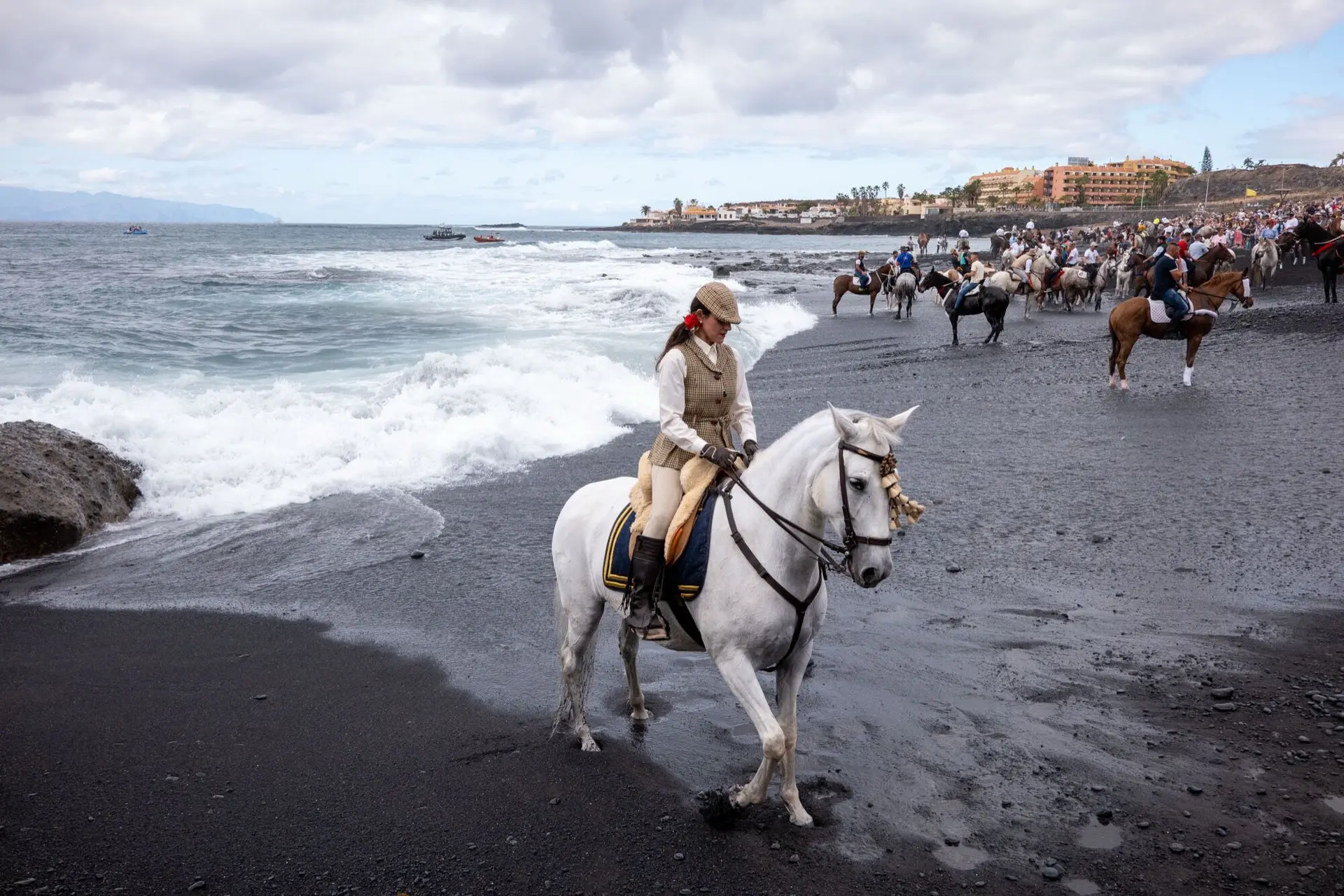
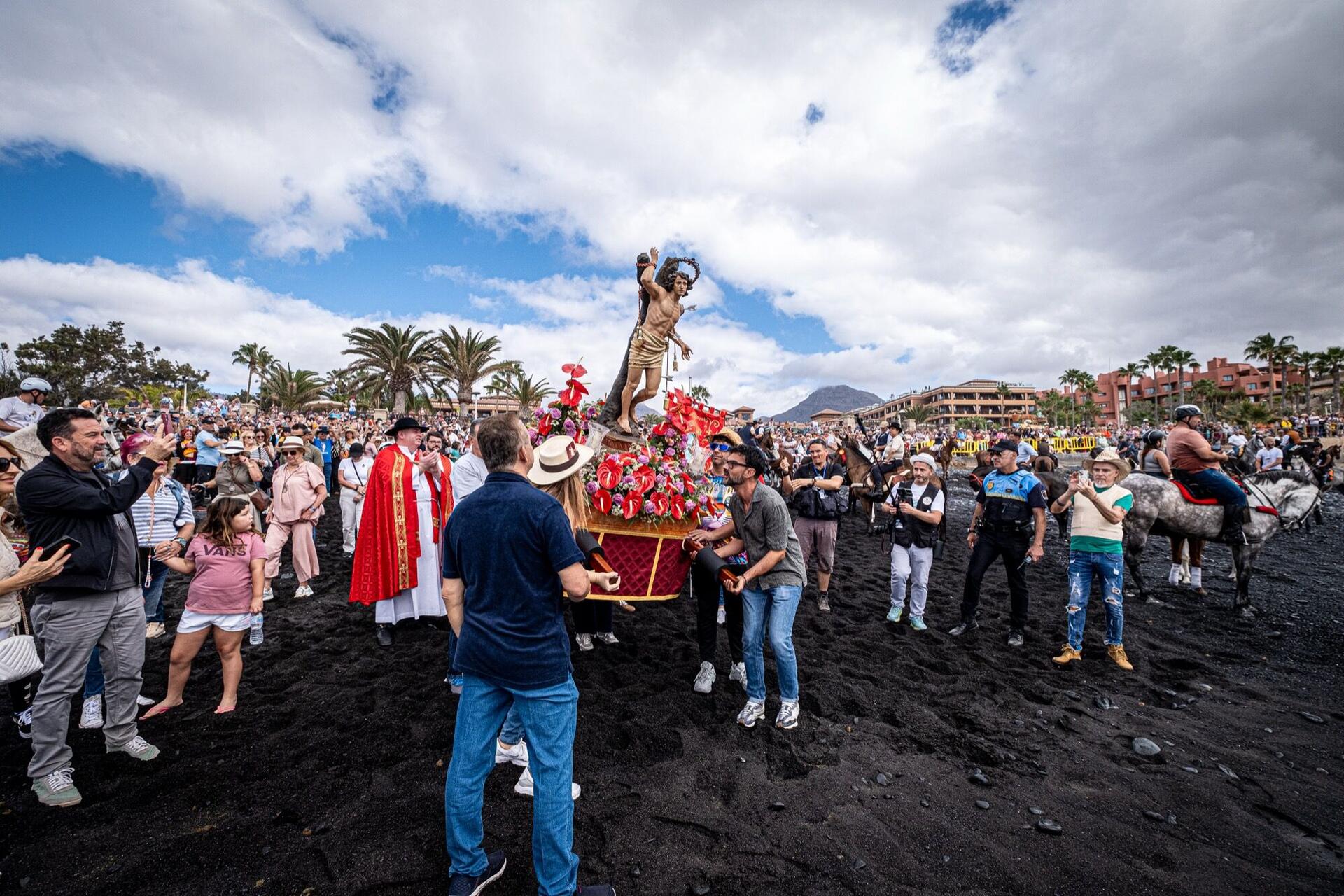
La Enramada beach will once again host the celebration of Adeje’s co-patron saint, which includes the traditional bathing of animals in the sea and attracts thousands of people from across the island
Adeje, 16 January 2026. – Adeje Town Hall has everything in place to celebrate its largest and popular festival, San Sebastián, this coming Tuesday, 20 January. The programme combines tradition and devotion with one of its most distinctive events, the bathing of animals at La Enramada beach. Dozens of riders on horseback, along with many other animals, create a spectacle that attracts thousands of visitors from across the island, both residents and tourists.
The celebrations begin on the eve of the festival, Monday 19 January, at 7.30 pm, with a mass in honour of San Sebastián Mártir, sung by Mesturao. This will be followed at 8.30 pm by a short procession with the statue of the saint, accompanied by the Adeje Patronal Band. On its return to the church, the traditional fireworks offering will take place. The evening will continue from 9 pm with a performance by Parranda Chasnera.
Tuesday 20 January is the main day of the festival. At 12 noon, a mass in honour of San Sebastián Mártir will be held, sung by the group Boleros de Armeñime. After the mass, the statue of the saint will be carried in procession along the usual route. The procession is preceded by riders and animals as far as La Enramada beach, where they carry out the bathing ritual and wait for the saint. Just before the statue returns to the church, another of the most anticipated moments takes place, the traditional blessing of the animals. The day will conclude with a final mass at 6 pm.
Adeje Town Hall reminds the public that the registration period to take part with animals ended today, Friday, a measure that helps guarantee the smooth running of the celebration and animal welfare. Adeje Town Hall’s Department of Culture, led by Adolfo Alonso Ferrera, always has a registered vet on site to attend to and oversee the wellbeing of the animals on the day of the event. In addition, the department, in coordination with the Local Police, puts a safety plan in place to ensure the safety of everyone attending.
History of a festival
The festival of San Sebastián has deep roots linked to Adeje’s historical and spiritual origins and to its relationship with the coast. Since the late 16th century, the saint has been venerated as a protector against epidemics and contagious diseases, a devotion shared by many coastal communities across the archipelago. In Adeje, this devotion became established at the Hermitage of the Encarnación, located next to the former port of La Enramada, a strategic area due to its contact with the outside world and therefore particularly vulnerable to the arrival of disease.
Over the centuries, devotion to San Sebastián became firmly established and took on its own distinctive character within the municipality. The arrival of the current statue of the saint on 20 January 1916 strengthened a devotion that was already deeply rooted among the population. Since then, the festival has remained a fixed date in the religious and popular calendar, celebrated without fail, and becoming one of the pillars of Adeje’s identity.
One of the most distinctive elements of this celebration is the close association of the saint with the protection of animals, which for generations were essential to the municipality’s agricultural and livestock-based economy. From this tradition comes the ritual of the blessing and subsequent bathing of the animals in the sea, an act rich in symbolism, that brings together faith, promise and purification, and which has endured to the present day as one of the most recognisable and eagerly awaited moments of the festival.
Today, the celebration of San Sebastián continues to act as a thread linking past and present. Popular participation, the prominence of the maritime setting and the passing down of these customs from generation to generation reflect the continuity of a tradition that forms part of Adeje’s cultural and religious heritage and keeps alive one of its most emblematic festive expressions.
More information, in Spanish, about the festival can be found at the following link:
https://www.adeje.es/patrimonio/blog/596-libro-san-sebastian-significad